
Half Life
This was not a creative genius, not a great musician, he was a phenomenon. He set out to be a phenomenon and succeeded, but I predict that the half life of this kind of radioactivity, which he certainly had, will be short and that he will be forgotten sooner than you think. Matthew Parris, Great Lives – David Bowie. BBC Radio 4 31/7/2018
 Many people (including me) felt that the World changed on 10th January 2016, when David Bowie died. Immediately, several spontaneous memorials or shrines appeared in London, with others reported near his home in New York and former home at Hauptstraße 155 in Berlin. Given that we were already interested in popular music heritage, and associated shrines and memorials, Hilary Orange and I embarked on a study of the Bowie shrines, and those dedicated to Marc Bolan (DOD 16 September 1977), Freddie Mercury (DOD 24 November 1991), Amy Winehouse (DOD 23 July 2011) and George Michael who died later in 2016 (25 December). We also explored evidence of similar phenomena around the World, and paid a visit to Graceland, Memphis Tennessee, the home of Elvis Presley, in January 2018. We produced a series of publications on this topic (Graves- Brown and Orange 2017, 2019, 2021)

Grave of Elvis Presley, Graceland
Among other things, the pandemic created a hiatus in these studies, but I was determined to revisit the Bowie shrines in London on 10 January 2026, the tenth anniversary of his death, in order to see how the shape of commemoration had changed over time. Indeed this research had always been thought of in terms of a longitudinal study, of which there are one or two other examples in contemporary archaeology (e.g. my work with John Schofield on the Sex Pistols and John’s research into Strait Street in Valletta, Malta).
My own interest in this area began in the early noughties. A conversation with John alerted me to the Bowie site in Heddon Street, which led to a study of pop related sites in central London (Graves-Brown 2012). Around the same time I had been visiting the “Magnificent Seven” Victorian cemeteries around London, and had noticed the somewhat florid way in which contemporary burials were being decorated by the bereaved. A study of pop related shrines seemed an obvious next step, with early visits to the Marc Bolan Shrine in Queen’s Ride, Barnes in 2013.
This new survey is an attempt to take these matters on, and to explore how the lapse of time changes commemoration.
Bandstand, Croydon Road Recreation Ground, Beckenham.
 The bandstand, erected 1905, is associated with a free festival held on 16 August 1969, organised by Bowie and the Beckenham Arts Lab. It was finally listed by Historic England after a campaign by local groups, in August 2019 Entry Number:1465007).
Though born in Brixton, Bowie spent most of his early life in Beckenham until, with rising fame, he left in 1972. Indeed, in January 2026, it was announced that his childhood home at 4 Plaistow Grove, Bromley would open to the public in 2027.
 Restoration work on the bandstand, largely funded by local fundraising (such as the annual Bowie’s Beckenham Bash festival), took place between July 2023 and March 2024. In addition to work on the structure itself, a paved area incorporating personalised bricks (one of the fundraising activities) was laid around the building, wit
 h a large commemorative plaque dedicated to the 1969 festival.
I spent around an hour in the middle of the day at the bandstand, but encountered little activity apart from two interested walkers who had stopped to examine the site. There were no items left at the site, apart from a black (probably artificial) rose, inserted between the paving blocks. It was notable that access to the bandstand itself is now prevented by a padlocked gate.
Three Tuns Pub, Beckenham
 The Three Tuns pub, which has been a Zizzi’s restaurant for at least 10 years, was the locus for meetings of the Beckenham Arts Lab, commemorated for more than 10 years by a plaque on the external wall. Internally there are two murals dedicated to Bowie. In 2019, Bromley Council inserted a large Bowie “Lightening Bolt” into the pavement outside the building. I am still investigating the exact process, in terms of agents and funding, through which this monument was created.

Bowie Mural, Morley’s Department Store, Brixton
This is a mural of Aladdin Sane/Bowie painted by Australian street artist James Cochran in 2013 on the wall of Morley’s Department store, Tunstall Road, Brixton. Created to coincide with the David Bowie Is exhibition at the Victoria and Albert Museum from March-July 2013. It has been, by far, the most popular location among the spontaneous Bowie shrines in London. I spent around an hour and 45 minutes there on 10/01/26. There was a steady flow of visitors, some leaving bunches of flowers in front of the mural and frequently having their photo taken. There were several professional photo journalists there capturing these visitors, some of whom arrived in Bowie themed clothing. According to the Guardian “The gathering has become a site of annual pilgrimage for some, but this year larger than usual crowds amassed to mark 10 years since the artist’s passing.”
As far as I can tell from the accompanying photographs, the journalist was present at the same time I was. However I think his “larger than usual crowds” is a bit of exaggeration; in the time I was there there were never more than around 10-12 people present, some of whom were journalists or archaeologists!! Unless they all waited till I had left.
Returning to the site on 24th January I saw no sign of any further offerings than those 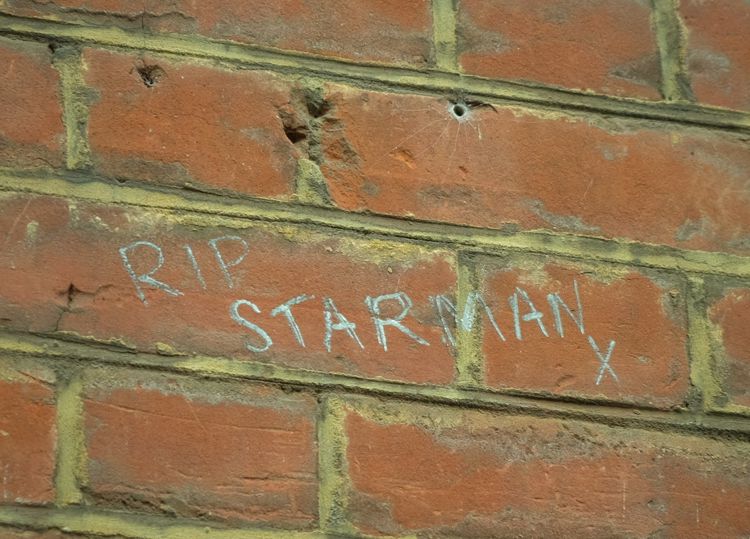 I had observed previously.
A notable change was the absence of graffiti. Initially visitors had graffitied the mural itself. Shortly after a sign was erected, asking visitors to refrain from doing so and in January 2017, immediately before the anniversary of Bowie’s death, a polycarbonate screen was installed to protect the mural. Graffiti on the wall to the left of the mural was rapidly removed by Morleys, but to the right the entire wall was covered with graffiti as far as the junction with Bernay’s Grove. As of 10/01/26, all of this graffiti had been removed except for one, seemingly fresh graffito, reading “RIP STARMAN X”
Bowie Birthplace, 40 Stansfield Road, Brixton
Number 40 Stansfield Road is the terraced property where David Robert Jones was born in 1947. It does not, as yet, bear any plaque or indication to this effect. In previous years we had observed a few offerings, such as candles, left on the wall outside the house. This year there was no sign that anyone had been there.
Plaque and Telephone Box, Heddon Street, W1
 Heddon Street, a narrow cul-de-sac off of the west side of Regent Street, was the location of the photoshoot for the cover of The Rise and Fall of Ziggy Stardust in 1972. The street has been a site of Bowie pilgrimage since at least the late 1970s, and the red phone box has been graffitied since at least 1985 (although the current box is a replacement K6 type installed in 1996 – see image and album cover inset). Whilst in early years a spontaneous shrine did appear below the Ziggy Stardust plaque erected by the Crown Estate in 2012, this did appear to tail off in subsequent years. As of 2026, there were no offerings at the site. Moreover, all graffiti had been removed from the telephone box and BT have placed a lock on the door. This replaced a set of chains around the box which were in place in 2023. In an email they told me “The kiosk has been locked up to the public and is due to have the mechanism removed and locked up to preserve the unit for future generations.” Though I have yet to ascertain what this entails.
 I have been exploring the possibility of the phone pox being given listed status, but the obvious obstacle to this is the fact that the Kiosk is not the original. This may however, not be a fatal impediment as there are precedents; the Zebra crossing in Abbey Road, St John’s Wood, is not the original photographed for the Beatles album cover, but appears to have been moved around 2m to the south at some point.

Image: Graphic Rewilding
One new item, however, is a large mural of the lightning bolt, adjacent to the phone box. This was created in April 2023 by the art consultancy Graphic Rewilding. They told me:
A few years ago Graphic Rewilding was commissioned as part of a wider project to rejuvenate Heddon Street. We created a holistic vision for the whole street which would act as a placemaking activation for the area – bringing attention and visitors to the shops and restaurants located there.
As part of the project, we planned to highlight the street’s connection to David Bowie / Ziggy Stardust – and in particular the phone box used in the famous Brian Ward photographs.
And so the mural was painted – featuring our trademark bold colour palette and larger than life florals. As you’ll see from our other work it is very much in keeping with the visual language of our practice; bringing maximalist nature inspired art into urban environments.
Unfortunately, after the mural had been completed, the project was actually cancelled and so the main installation on Heddon Street was never realised.
Forgetting: Memorial trajectories
What are we to make of this? Is Matthew Parris right that we are experiencing a “halflife” in popular enthusiasm for Bowie? Certainly the 10th anniversary has been marked by new publications, a new documentary from Channel 4, extensive coverage in the media and a new afternoon tea inspired by the life and work of Bowie at Café Royal Grill on Regent Street.
Yet what we might term the physical footfall at tribute sites is nowhere near what it was in 2016 and 2017. The annual Bowie’s Beckenham Oddity festival at the bandstand now seems to have ceased since the funding for its restoration has been achieved. Clearly the initial shock at Bowie’s death would have been a much greater stimulus than the tenth anniversary. Yet by comparison, Elvis birthday celebrations (8th January) and the upcoming Elvis Week in Memphis (centred on Elvis DOD on 15/07/77) are still major events.
One possible way to view the changing situation is to observe a process of fossilisation or inertia taking place. Thus, whilst there are fewer spontaneous visits taking place, the sites (with the exception of Tunstall Road) now have greatly elaborated permanent memorials of one kind or another. In many cases where no such memorial previously existed. Whilst most of the permanent Bowie memorials have been created since 2019, it is of course the case that James Cochran’s mural predates Bowie’s death. Whilst this remains the most popular pilgrimage site, it is interesting the Bowie memorialisation in Brixton remains in flux. The “Ziggy Zag” (see below) never materialised, and as yet there seems to be no plan to place a blue plaque in Stansfield road, Bowie’s birthplace, even whilst his later home in Beckenham is to become a museum.
Earlier histories of spontaneous shrines are a good starting point for understanding the trajectories of contemporary phenomena.
The meaning of war memorials was bound to change. They could have no fixed meaning, immutable over time. Like many other public objects, they manifest what physicists, in an entirely different context, call a ‘half-life’, a trajectory of decomposition, a passage from the active to the inert…now, seventy-five years after the armistice, war memorials have become the artefacts of a vanished age… Winter 1995: 98.
Winter’s example reveals the ways in which a memorial transforms over time from a site of memory production, to a site of history production. Over time, the audience’s connection to those memorialised becomes more distant, more abstract. Lohman 2006:209

Palace Road, Hackney 1916
There is, of course, a long history of wayside shrines in Europe and elsewhere, but the First World War provides a prime example of the transition from spontaneous shrines to permanent monuments. Though little known today, there were a plethora of spontaneous shrines in the UK, beginning in 1916. Whilst some accounts, probably rightly, suggest a connection with the Battle of the Somme which began on the 1st July, the shrine at the church of St John of Jerusalem in South Hackney is said to date from April 1916. Subsequently hundreds of such shrines were created (possibly more than 300 in London alone), such that by August an enterprising company were offering a ready made wooden shrine for 6s 6d. The origin of these shrines is also debatable. King (1998) argues that they were almost exclusively promoted by local clergy, whereas Connelly (2002) suggests that whilst this may have been the case in working class areas, middle class people took it upon themselves to create local shrines. The entire movement culminated in the unveiling of a national war shrine in Hyde Park on 4th August 1918 (the 4th anniversary of the outbreak of war), a monument that seemed likely to become a permanent memorial, but which was ultimately superseded by the Cenotaph in Whitehall (Lutyens certainly visited the Hyde Park shrine).
Whilst these shrines were clearly very popular, they were not without controversy, as has been the case with more recent examples (see Lohman 2006 and other chapters in Santino). The more puritanical of protestants were highly critical of street shrines, regarding them as examples of undue Roman Catholic influence. This controversy could itself lead to violent confrontation. In April 1917, the Rev. J. A. Kensit (a vocal critic of shrines) was physically attacked after giving a speech on the subject.
Whilst most of the spontaneous shrines disappeared in the aftermath of the war, particularly as permanent war memorials were being erected around the country in the early 1920s, some survived and were themselves converted into more permanent memorials. Such was the case with the shrine in Cyprus Street, Bethnall Green.
There do seem to have been spontaneous shrines in the Second World War, but I have encountered little hard evidence to date. In any case the memorialisation of the Second War is patchy. Whilst names of the dead were usually added to existing First World War monuments, events such as the London Blitz gained little in the way of public monuments (see Moshenska 2010). In more recent years, the pattern of spontaneous shrines, followed by more permanent monuments is reiterated in many cases, such as the death of Princess Diana, 9/11 in New York and Washington or the ongoing process of memorialising Queen Elizabeth II (Holbrook 2025). In this, the shrines to David Bowie, and the Marc Bolan shrine in Barnes, seem to follow the patter n. And, like the First World War shrines, tributes to Bowie have not been without controversy. The “Ziggy Zag”; a 9m high sculpture that was to be placed next to the Brixton mural never materialised. A crowdfunder was launched in February 2016, with support from Lambeth council, but by March it was reported that the plan had been abandoned due to lack of funds. There was, according to some accounts, considerable opposition from some sections of the local community, particularly those who saw it as detracting from nearby Windrush commemoration. Similarly, one might argue, the construction of a protective screen on the Tunstall Road mural is indicative of a conflict between official and popular involvement with the shrine. The monument to Bowie in Aylesbury was vandalised twice shortly after its construction, whilst a Bowie mural in Sheffield was widely criticised, if not indeed mocked for its inauthenticity.
The lightning bolt in Beckenham High Street also elicited controversy;
ALL is not hunky dory in the south-east London suburb where David Bowie performed before becoming a starman. A colourful tribute to the Ziggy Stardust singer outside the pub where he launched his career has been slammed by locals on Facebook.They say it looks like ‘graffiti’, could be ‘mistaken for a hole by people with dementia’ and is ‘a waste of good paint’. One poster, Marie Dye, wrote: ‘A rubbish tribute to a great artist.’ The iconic flash — from 1973 album Aladdin Sane — was built into the pavement outside the former “Three Tuns” pub which is now a “Zizzi” Italian restaurant. Bowie — who died aged 69 in 2016 — set up the Beckenham Arts Lab there in May 1969.
The street art was installed as part of a £4.4million improvement scheme for Beckenham high street funded by Bromley Council and Transport for London. Councillor Peter Morgan said it was installed ‘to recognise the role Beckenham had in the early part of David Bowie’s career’. But disgruntled residents may yet press for ch-ch-changes. Metro 16th August 2019
As Winter (1995) points out, it is usual to regard war memorials in the context of their political meaning, but they have, or had, more immediate social and emotional meaning. For the survivors of the “Great” war and the families of the dead, the shrines, and the permanent memorials that followed them, were focii for mourning and commemoration. Hence, one might suggest, the controversy that surrounded them was the result of passionate emotions (reiterated, perhaps, in the Bowie shrines?).Whilst these rituals continue to survive in the UK and elsewhere in Europe, those who were impacted personally are now dead. As Lohman says of more contemporary shrines to victims of street violence in Philadelphia, memorials shift from memory production to history production. And on into obscurity. There are, for example, around 16 public memorials to the dead of the Crimean War, usually raised by private subscription. One such stands in the centre of Carmarthen, but it is doubtful if most passers by even know of its purpose. It is tempting to think that this will also be the fate of the more permanent Bowie memorials; that they, as both Parris and Winter suggest, will have a halflife as they gradually pass into obscurity. Indeed Lohman suggests that murals, unless they are refreshed, have a physical life of no more than 25 years (see also Mccormick and Jarman 2005).

Antimonumento +43 – source, see Note 1
In fact, one might argue that the permanent memorial is actually a facilitator, or step on the way to forgetting; “the monument is more an impediment than an incitement to public memory” (Young 1993: 27). As he has argued in connection with Holocaust memorialisation, the movement to create counter monuments or anti-monuments, particularly in Germany, is a recognition of the failure of traditional monuments to preserve memory. Or indeed of their role in effacing the past by promoting a particular narrative. Indeed in Latin America, anti-monuments have become a feature of political protest; Antimonumento +43 was erected outside the Superior Court of Justice of Mexico City, commemorating forty-three students kidnapped, and possibly killed, in Iguala, Guerrero, in 2014. It was the first of a number of such antimonumento in Mexico. Here it is worth remembering that the street shrine and its successors may themselves be a form of anti-monumentality, in reaction to the controlled and restrictive environment of the churchyard or public cemetery. Even today, when the tendency to elaborately decorate the graves of the dead has had a considerable efflorescence, it is not uncommon to see local authority notices placing restrictions on how graves are embellished.
In the case of the Bowie shrines, the fact that there is no actual grave to venerate is at the heart of the creation of these monuments. As was also the case with Freddie Mercury, Bowie seems to have wanted to avoid any public focus for his death. A reaction, it would seem, to the circus around Graceland. Similarly, the shrine to George Michael that grew up in Highgate reflects the fact that his actual grave is inaccessible (in the private cemetery at West Highgate). And when objects of veneration have been cremated, as in the cases of Marc Boland and Amy Winehouse, the existence of actual memorials (the plaque to Bolan in Golders Green Crematorium and the Winehouse memorial at Edgwarebury cemetery) do not seem to fulfil the needs of mourners. The spontaneous shrines reflect the need for the same public space of remembrance that we see in the First World War. And as in the latter case, it is likely that these will in time pass from memory to history.
Acknowledgements
Thanks go to: India Coles (Graphic Rewilding), Carolyn Graves-Brown, Jonathan Liggins (BT), Hilary Orange, Layla Renshaw, Vicky Walker (Bromley Libraries), Helen Wickstead, Steven Woodbridge.
References
Connelly, Mark. 2002 The Great War, Memory and Ritual. London, The Royal Historical Society.
Graves-Brown, P. 2012 ‘Where the Streets Have no Name: A Guided Tour of Pop Heritage Sites in London’s West End’, in S. May, H. Orange, and S. Penrose (eds) The Good, the Bad and the Unbuilt: Handling the Heritage of the Recent Past (Oxford: British Archaeological Reports International Series 2362.
Graves-Brown, P. and H. Orange. 2017 “The Stars Look Very Different Today”: Celebrity Veneration, Grassroot Memorials and the Apotheosis of David Bowie. Material Religion. 13(1)
Graves-Brown, P. and H. Orange. 2019 ‘My death waits there among the flowers’
Popular music shrines in London as memory and remembrance. In Sarah De Nardi, Hilary Orange, Eerika Koskinen-Koivisto, Danielle Drozdzewski and Steven High The Routledge Handbook of Memory and Place. London, Routledge.
Graves-Brown, P. & Orange, H. 2021. Station to station: Rock music memorial roots and routes in London. In Liam Maloney and John Schofield (Ed.), Music and Heritage: New Perspectives on Place-making and Sonic Identity. London, Routledge
Holbrook, Ceri 2025 “We are Asking People not to Leave Marmalade Sandwiches”: The Contested Heritage of Public Mourning. Heritage & Society , 18(3), pp 374–396
King, Alex. 1998 Memorials of the Great War in Britain : The Symbolism and Politics of Remembrance, London, Bloomsbury Publishing
Lohman, Jonathan 2006 A memorial wall in Philadelphia. In Jack Santino (ed) Spontaneous Shrines and the Public Memorialisation of Death. pp177-214 New York: Palgrave MacMillan
Mccormick, J., & Jarman, N. (2005). Death of a Mural. Journal of Material Culture, 10(1), 49-71.
Moshenska, Gabriel 2010 Charred churches or iron harvests? Counter-monumentality and the commemoration of the London Blitz Journal of Social Archaeology Vol 10(1): 5–27
Winter, Jay. 1995 SItes of Memory, Sites of Mourning. Cambridge, Cambridge University Press
Young, James E.1993 The Texture of Memory Cambridge (Mass), Yale University Press
Notes
1)Image source https://commons.wikimedia.org/wiki/File:Ayotzinapa45meses_ohs37.jpg
Leave a Reply